Making Tax Digital for Income Tax: what it is, and what changes
Checked against GOV.UK on 14 August 2026 · Applies from 6 April 2026 onwards.
“MTD is simply using a computer to supply hmrc with the same information you currently supply by paper, and quarterly.”
We hear this most. a landlord answering a frightened one, OpenRent Community forum, 31 July 2026 — someone in the same position as you.
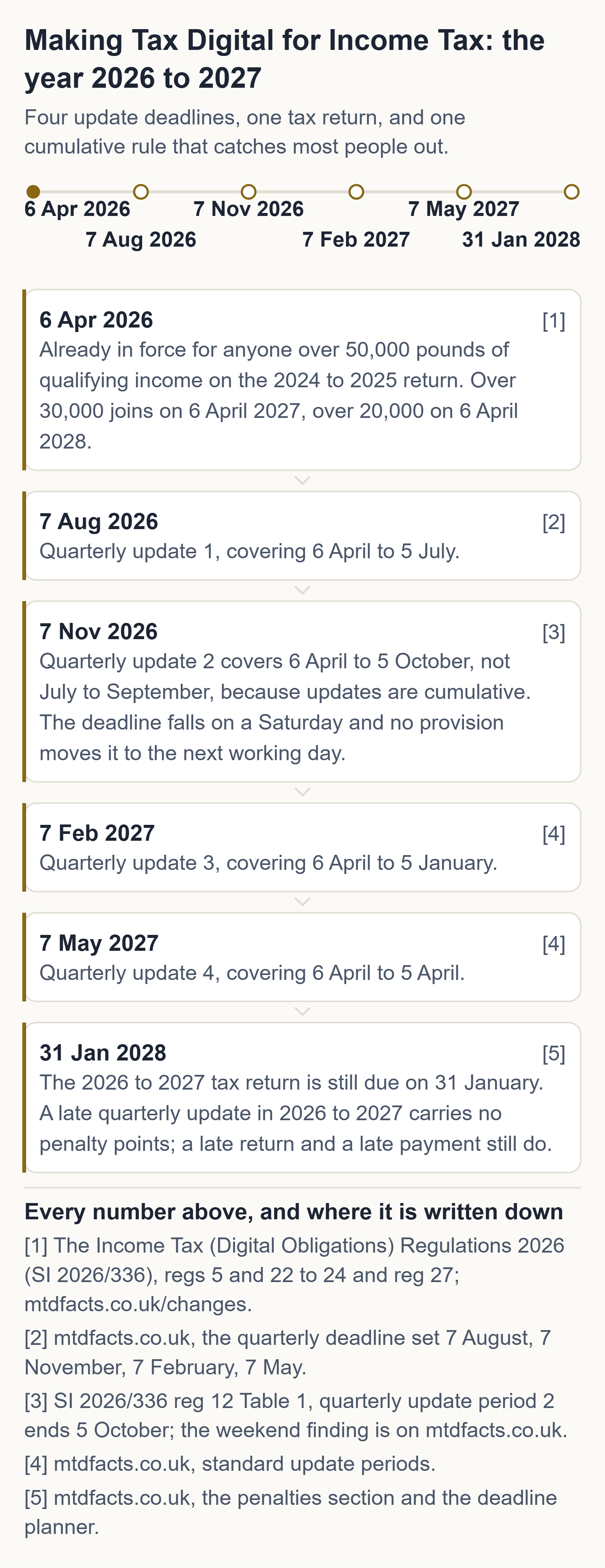
If Making Tax Digital applies to you, three dates matter and nothing else does. Your next quarterly update is due 7 November 2026, and because updates are cumulative it covers 6 April to 5 October 2026 — so it also catches up 7 August 2026 if you missed it. Your tax return for 2026 to 2027 is due 31 January 2028, and that one is still in the points system. And from September 2026 HMRC has been signing people up itself, in stages, if they had not signed up.
You are not alone, and this is the measured version of that sentence. HMRC put 864,000 sole traders and landlords in scope for this tax year (HMRC, 5 February 2026), and reported on 12 August 2026 that 436,000 had sent a first quarterly update and 570,000 had signed up. We have not subtracted one from the other to make a "how many are behind" headline — they were published six months apart and count different things — but you can see the size of the room you are standing in.
What to do tonight
twenty minutes, tonight, with last year's tax return in front of you
- Find your gross self-employment income and your gross property income on the tax return you filed last — the totals before any expenses. Those two numbers, added together, decide everything else.
- Put them into the free checker on this site. It runs in your browser, asks for nothing else, and tells you whether you are in and from which April.
- If it says you are in, write 7 November 2026 on your calendar tonight. That is the next thing that is actually due.
None of those three steps costs money. Anyone charging you to do them is selling you something HMRC gives away.
Where these come from, on GOV.UK: quarterly updates and their deadlines · the tax return · who has to use MTD, and when · working out qualifying income · the recognised-software finder · what to do if HMRC signed you up.
The free route, before anyone sells you a subscription
HMRC publishes the official list of software recognised for Making Tax Digital for Income Tax, and its own guidance says plainly that “free products are available for those with simple tax affairs”. We drove that finder ourselves on 1 September 2026 and it returns recognised products costing £0 — for sole traders and for landlords, including bridging tools that submit straight from a spreadsheet you already keep. We take no commission from any of them, we rank none of them, and this site carries no affiliate links.
HMRC's official software finder (gov.uk) · how bridging software works · the free two-number check · your own four dates
Signing up for Making Tax Digital is free at GOV.UK. So is the checker on this page, and so is every answer on this site.
Making Tax Digital for Income Tax changes how sole traders and landlords record and report income. Three things change: your records move into software, you send four summaries a year, and your tax return is filed from that same software.
The three changes, and nothing else
1. Digital records
You create and store a digital record of every item of self-employment and property income and expense, in software that works with Making Tax Digital. Each record needs the amount, the date, and the category.
2. Quarterly updates
Every 3 months your software totals those records by category and sends the totals to HMRC. HMRC never sees individual receipts or invoices. These are summaries — HMRC's own guidance is explicit that they are not tax returns, and you make no accounting or tax adjustments before sending one.
3. The tax return moves into the software
After the fourth update you add your other income, make your adjustments, and submit the tax return from the software. The deadline does not move: 31 January after the end of the tax year.
What does not change
- The tax return deadline is still 31 January.
- The dates you pay tax do not change, and payments on account work as before.
- You still keep your original paperwork — bank statements, invoices, receipts — exactly as you do now for Self Assessment.
- Quarterly updates do not mean paying tax quarterly.
Who it applies to right now
Sole traders and landlords registered for Self Assessment whose qualifying income is over the threshold for their year:
| Qualifying income | On the tax return for | You must use MTD from |
|---|---|---|
| Over £50,000 | 2024 to 2025 | 6 April 2026 — already in force |
| Over £30,000 | 2025 to 2026 | 6 April 2027 |
| Over £20,000 | 2026 to 2027 | 6 April 2028 |
| £20,000 or less | — | Automatically exempt, unless your circumstances change |
Partnerships do not currently need to use it. HMRC has said it will set out the timeline for partnerships later.
Questions people ask
Is a quarterly update a tax return?
No. HMRC describes quarterly updates as summaries of income and expenses, not tax returns. You still submit one tax return a year by 31 January.
Do I pay tax every quarter under MTD?
No. Making Tax Digital does not change when you pay tax or the dates payments are due.
Do all self-employed people have to go digital?
No — it turns on gross income, so you are brought in only when your qualifying income from self-employment and property is above the threshold for that phase, and below it you carry on filing a tax return as before.
What will Making Tax Digital mean?
In practice it means keeping your business records digitally, sending a summary of income and expenses to HMRC four times a year, and finishing the year with a final declaration instead of assembling everything once.
Can I avoid Making Tax Digital?
Not as a preference: the ways out are the exemptions, which are either automatic — qualifying income at or below the lowest threshold, or no National Insurance number — or applied for, as being digitally excluded is.
How much do I need to earn to make tax digital?
It is gross income rather than profit that decides it, and the qualifying-income threshold steps down through the phase-in, so the figure that applies to you depends on which tax year brings you in.
Andrew at Axion Labs
I built this site because my own first read of the MTD guidance took an afternoon and left me less sure than when I started. The rules aren't secret — they're all on GOV.UK — they're just spread across a dozen pages, and the answer to one ordinary question is usually split across four of them. So: one question, one page, sources at the bottom, and the date I checked them. If something here reads as wrong to you, it might be. Tell me and I'll fix it that day.
Sources
- Find out if and when you need to use Making Tax Digital for Income Tax (HMRC guidance)
- Use Making Tax Digital for Income Tax: send quarterly updates (HMRC guidance)
- Use Making Tax Digital for Income Tax: create digital records (HMRC guidance)
- Use Making Tax Digital for Income Tax: submit your tax return (HMRC guidance)
General information about UK tax rules, not tax advice. Your own circumstances and HMRC's official guidance govern your position. If you are unsure, speak to an accountant or contact HMRC. Tax rules change — if this page is more than a few months old, check the GOV.UK pages linked above. Found an error? Email hello@getaxionlabs.com and we will correct it.
← All Making Tax Digital answers
Thank you. That goes straight to the person who writes these pages.
That didn't send — try once more.