Making Tax Digital threshold: are you over it, and from when?
… just check that the income from that is over £50k pa …
— OpenRent Community forum, 31 July 2026
Two numbers settle it, against all three thresholds: £50,000, £30,000, £20,000.
Do not include employment (PAYE) income, a partnership profit share, dividends, State Pension or private pensions — none of them count towards qualifying income.
The thresholds are £50,000 from April 2026, £30,000 from April 2027 and £20,000 from April 2028, and they are measured on gross income from self-employment and property added together — not on profit, and not on each business separately. The checker above tells you which year you are in, or that you are in none of them. Nothing is sent anywhere and nothing is stored. Checked against GOV.UK on 14 August 2026.
Free to read. No sign-up, no cookies, no trackers. We never ask for your name, National Insurance number, or tax figures — the tools on this site run entirely in your browser.
What this tool does and does not do
It applies HMRC's published thresholds and automatic exemptions to the numbers you type. It does not know about ceased income sources, an accounting period shorter than 12 months, a digitally excluded application, or anything else specific to you.
Partnerships do not currently need to use MTD. Trusts (SA900), non-resident companies (SA700) and personal representatives are automatically exempt.
Where every threshold on this page comes from
Every threshold and date here is taken from GOV.UK and from the statutory instrument that set it, with the regulation number and the day we read legislation.gov.uk recorded on our changes page — which also records that the 2026 regulations revoked the 2021 and 2024 ones, so guidance still citing those is citing revoked law. Nothing is sold on this page.
Four emails a year, and nothing else
One three weeks before each of your four quarterly update deadlines — the dates are fixed and this site already works them out — and one when a threshold, a deadline or a rule on this page changes, with what changed and the date we read it. No newsletter, no offers, no third parties, and one click unsubscribes.
Nothing on this page is behind that field. Written and sent by Andrew at Axion Labs; reply to any of them and one person reads it. We store the address and nothing else — no name, no figures, no tracking — and no email has been sent from this list yet: the sending step is not built, and we would rather say so than imply a welcome message that is not coming.
What counts as qualifying income → Every exemption → Planner incl. foreign property income →
“As you only have two properties, just check that the income from that is over £50k pa. If not, you do not need to do MTD yet.”
We hear this most. a landlord telling another one to check before panicking, OpenRent Community forum, 31 July 2026 — someone in the same position as you.
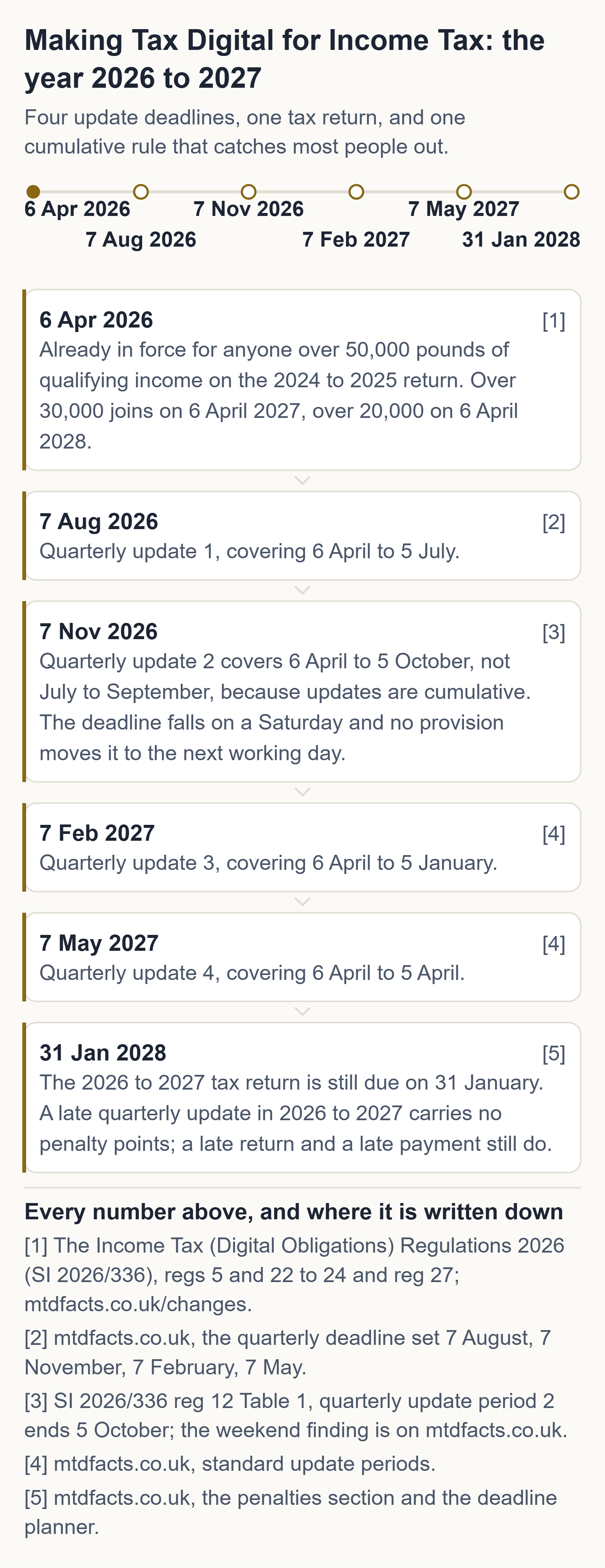
If the answer turns out to be yes, these are the dates you inherit. Your next quarterly update is due 7 November 2026, and because updates are cumulative it covers 6 April to 5 October 2026 — so it also catches up 7 August 2026 if you missed it. Your tax return for 2026 to 2027 is due 31 January 2028, and that one is still in the points system. And from September 2026 HMRC has been signing people up itself, in stages, if they had not signed up.
You are not alone, and this is the measured version of that sentence. HMRC put 864,000 sole traders and landlords in scope for this tax year (HMRC, 5 February 2026), and reported on 12 August 2026 that 436,000 had sent a first quarterly update and 570,000 had signed up. We have not subtracted one from the other to make a "how many are behind" headline — they were published six months apart and count different things — but you can see the size of the room you are standing in.
What to do tonight
fifteen minutes, tonight, and it may end with you doing nothing at all
- Add your gross self-employment income to your gross property income, from the tax return you filed last. Before expenses. That total is the only figure that matters.
- Compare it against your year's line: over £50,000 on the 2024 to 2025 return means you are already in; over £30,000 on the 2025 to 2026 return means April 2027; over £20,000 on the 2026 to 2027 return means April 2028.
- If you are under the line, stop. There is nothing to apply for and nobody to ring — the exemption is automatic, and none of the rest of this page applies to you.
None of those three steps costs money. Anyone charging you to do them is selling you something HMRC gives away.
Where these come from, on GOV.UK: quarterly updates and their deadlines · the tax return · who has to use MTD, and when · working out qualifying income · the recognised-software finder · what to do if HMRC signed you up.
The three lines, and the return each one is measured on
| Qualifying income | On the tax return for | You must use MTD from |
|---|---|---|
| Over £50,000 | 2024 to 2025 | 6 April 2026 — already in force |
| Over £30,000 | 2025 to 2026 | 6 April 2027 |
| Over £20,000 | 2026 to 2027 | 6 April 2028 |
| £20,000 or less | — | Automatically exempt, unless your circumstances change |
Qualifying income is gross self-employment income plus gross property income, before expenses, taken from the tax return you filed in the previous tax year. Sources: find out if and when you need to use MTD and work out your qualifying income (GOV.UK).
The free route, before anyone sells you a subscription
HMRC publishes the official list of software recognised for Making Tax Digital for Income Tax, and its own guidance says plainly that “free products are available for those with simple tax affairs”. We drove that finder ourselves on 1 September 2026 and it returns recognised products costing £0 — for sole traders and for landlords, including bridging tools that submit straight from a spreadsheet you already keep. We take no commission from any of them, we rank none of them, and this site carries no affiliate links.
HMRC's official software finder (gov.uk) · how bridging software works · the free two-number check · your own four dates
Signing up for Making Tax Digital is free at GOV.UK. So is the checker on this page, and so is every answer on this site.
Questions people ask
What does MTD mean?
MTD is short for Making Tax Digital, the HMRC programme for keeping business records digitally and reporting income and expenses during the tax year rather than only after it has ended.
Why are HMRC bringing in MTD?
The reason HMRC gives is fewer errors: records kept in software as you go, and figures reported during the year rather than reconstructed from paperwork months later.
Is there any free MTD software?
Yes — eight of the ten HMRC-recognised products we priced have a version that costs nothing, each under its own stated condition, and the priced table is on our free MTD software page.
Do I need to register for MTD with HMRC?
Yes, signing up is a separate step you take yourself on GOV.UK with your Government Gateway user ID, and it is free — anyone charging you to register is charging for something GOV.UK provides for nothing.
Is Hammock HMRC approved?
We have not verified this yet.
Can I still use bridging software for MTD?
Yes — bridging software takes the totals out of the spreadsheet you already keep and sends them to HMRC, and the one thing it does not let you do is retype the figures by hand.
What is the cheapest MTD software for landlords?
The cheapest costs nothing: several of the landlord-capable products we priced have a free version, and what separates them is the condition beside the price rather than the price itself.
How to avoid paying 40% tax on rental income?
We have not verified this yet.
How much do you need to earn to make tax digital?
Gross income decides it, not profit, and it is your self-employment and property income added together and tested against the threshold in force for the year that brings you in.
Am I exempt from Making Tax Digital?
You are exempt automatically if your qualifying income is at or below the lowest threshold or you have no National Insurance number; other exemptions, such as being digitally excluded, have to be applied for.
Will HMRC tell me if I need to do Making Tax Digital?
HMRC writes to people it believes are in scope and has begun signing some of them up itself, but a letter is confirmation rather than the trigger — the duty follows your income, so check it above rather than wait.
Do sole traders have to do Making Tax Digital?
Only above the threshold: a sole trader whose gross self-employment and property income is over the figure for that phase is in, and one below it is not.
How much can I earn before MTD?
You stay outside it while your combined gross self-employment and property income is at or below the threshold in force for that tax year, and the checker above works out which threshold that is.
Will HMRC let me know if I need to do MTD?
HMRC has been writing to taxpayers it expects to be in scope, but the checker above answers the same question from your own two figures without waiting for the post.
What is the threshold for MTD from April 2026?
£50,000 of gross self-employment and property income, tested on the 2024 to 2025 tax return.
Who is automatically exempt from MTD?
Qualifying income at or below the lowest threshold, having no National Insurance number, trusts, personal representatives of someone who has died and non-resident companies — none of these needs an application.
Andrew at Axion Labs
Some people who land on this page turn out not to be in Making Tax Digital at all, and I'd rather you found that out here in two minutes than after paying for a year of software. The threshold is gross and it's combined — turnover, both sources added together, before expenses. If that puts you under the line, there's nothing to apply for and nobody to ring. Close the tab with my blessing.
General information about UK tax rules, not tax advice. Your own circumstances and HMRC's official guidance govern your position. If you are unsure, speak to an accountant or contact HMRC.
Thank you. That goes straight to the person who writes these pages.
That didn't send — try once more.